Survival protects every damage source and the hull-dependent critical bonuses.
01 / Objective
Damage over time. Built as a complete system.
This is Alan Payne’s preferred Temporal Disruptor variation of an Unconventional Systems beam build. The aim is to develop the weapons’ damage over time while keeping the entire ship alive, powered, in position, and attacking.
It is an advanced, equipment-intensive example. Many other Unconventional Systems builds work. This guide explains the jobs and interactions behind this particular selection so readers can evaluate alternatives rather than copy a shopping list.
Speed, firing arcs, target access, and Fire at Will coverage preserve productive time.
The Temporal arrays consume auxiliary power. Supply and drain mitigation must support them.
Haste, both damage categories, critical performance, and resistance reduction work together.
Control abilities and console cooldown reduction improve the availability of powerful actives.
Console attacks, weapon effects, crystals, and shield retaliation all contribute to the total.
Every component must improve at least one of these conditions, contribute worthwhile damage, or enable another component that does.
How to read damage and critical bonuses
Bonuses within a damage category commonly add together; different parts of the damage calculation multiply. Category 1 and Category 2 both matter. A Category 2 increase is not automatically the best next upgrade: compare the relative gain to the existing pools and the rest of the build.
Critical severity pays only on a critical hit. For an otherwise identical attack, the average critical factor is approximately 1 + critical chance × critical severity, with both entered as decimals. Effective chance cannot exceed 100%. Alan checks weapon-only critical rates in the parse and usually favors severity once those rates exceed 90%; this is his working rule, not a universal optimization threshold. Compare [CrtD] and [Dmg] within the complete build.
A higher power ceiling is useful only when actual power can reach it under fire. Reducing consumption, supplying power, and recovering power are different jobs. Damage from one source may use different scaling rules from another; no single short formula safely describes this entire ship.
02 / Eight weapons
Six Temporal arrays. Two complementary omnis.
| Position | Equipped weapon | Owner-confirmed upgrades |
|---|---|---|
| Fore 1–5 | 5 × Temporal Disruptor Beam Array | Mk XV Epic · [CrtD/Dm] [CrtD]×4 |
| Aft 1 | Omni-Directional Pahvan Proton Beam Array | Mk XV Epic · [Arc] [CrtD/Dm] [CrtD]×3 |
| Aft 2 | Omni-Directional Interlacing Tetryon Beam Array | Mk XV Epic · [Arc] [CrtD/Dm] [CrtD]×3 |
| Aft 3 | Temporal Disruptor Beam Array | Mk XV Epic · [CrtD/Dm] [CrtD]×4 |
Temporal Disruptor arrays
The six arrays are the core of the DoT experiment. They have a 250° firing arc and consume auxiliary power. Temporal Incision supplies a physical damage-over-time effect that ignores shields; its interaction with Entropy is a separate testing question.
Alan has seen displayed DoT values reach roughly 1,500 damage per second per weapon. That is an observed display value, not proof of six independently stacking effects or 9,000 actual DPS. Stacking, refresh behavior, and peak values still need controlled testing.
Why these aft weapons?
The Pahvan omni adds proton damage and its resonance effect. The Interlacing Tetryon omni adds tetryon damage and Tholian Warp Crystals. Both have 360° arcs, helping them stay engaged while the ship turns or changes position.
Alan’s isolation tests identify the Tholian omni as the principal source of the unusually large crystal contribution. The Tholian core appears to improve it slightly; the exact two-piece contribution remains unmeasured.
Identity correction: the recording/parser labels the last array “Advanced Disruptor.” Alan confirms that it is another Temporal Disruptor. This inventory follows his confirmation and retains the label mismatch as unresolved.
Twinkling Lights still has a job
This build uses two of the six qualifying primary energy types: Disruptor and Tetryon. Twinkling Lights applies −12 Damage Resistance Rating per qualifying type, so both types hitting a target provide −24 rating for Alan’s outgoing damage until that enemy is defeated. Proton is not a third qualifying type. A resistance-rating change is not the same thing as a flat percentage damage increase.
Broadside positioning remains important, but the arrays and omnis do not share identical arcs. Keep useful targets inside the arrays’ 250° arcs as often as possible.
03 / Fourteen consoles
Each slot earns its place.
Open an item for its purpose and tradeoffs. Several favorite damage consoles from the earlier build were displaced to make room for DoT support. This is a fresh inventory of the October 15 recording.
Custom Power MatrixUniversal 1 · Power recovery, with optional toggle benefits
In a Universal slot its passive grants +120% Power Transfer Rate. Its toggles can trade subsystem power for weapon haste, critical severity, or critical chance; while any is active it also grants BOFF recharge speed. Alan dislikes their tendency to deactivate. Toggle benefits are conditional and should not be treated as permanent.
Bioneural Infusion Circuits · Mk XV EpicUniversal 2 · Critical severity with hull and control support
The recorded tooltip gives +26.2% Critical Severity and +29.5 Hull Capacity and Control Expertise skill. Its primary offensive job is severity in a build with strong weapon critical rates; hull and control skills support other systems. Control Expertise is a skill value, not a guaranteed equal percentage increase in a control effect.
Fek’ihri Torment Engine · Mk XV EpicUniversal 3 · A dedicated DoT investment
The tooltip lists +39.4% non-hazard DoT damage and +39.4% Fire, Radiation, Plasma, and Physical damage. Non-hazard DoT can also trigger an additional shield-ignoring fire attack. Physical damage support is relevant to Temporal Incision. Its own parse row understates its full value because passive benefits appear under the damage sources they improve.
Shield Absorptive Frequency GeneratorEngineering 1 · Energy weapon fire helps restore shields
When a facing is below 90%, energy weapon shots have a 2.5% chance to restore shields for 200% of outgoing damage, according to the supplied tooltip. It helps sustain the ship and return facings above the Khitomer shield’s 25% retaliation-rearm threshold. This is chance-based recovery.
Sigma StratagemEngineering 2 · DoT and critical support in one slot
The recorded passives are +30% DoT damage and +5% Critical Chance. The active grants +20% Critical Chance for 30 seconds and lets critical hits grant firing-cycle haste to self and nearby allies. Its jobs extend beyond the DoT passive; assess chance against actual weapon critical rates to avoid wasting excess.
Spirit of SacrificeEngineering 3 · Passive drain mitigation and range support
Its passives set the energy weapon range penalty to minimum and reduce weapon firing power drain by 50%. Alan’s tests show that the reduction also applies to the Temporal arrays’ auxiliary consumption. He does not rely on its shield-sacrificing cooldown active because cooldown support comes from elsewhere.
You Are DismissedEngineering 4 · A separate area damage source
The active delivers a shield-ignoring proton burst and physical DoT around the ship, with an additional chance for Protonic Crush. It also pushes enemies, making positioning and timing relevant to whether that displacement helps or harms the next attacks.
Lure Team CommandEngineering 5 · Another deliberate DoT console choice
Its passives provide +30% DoT damage and +20% Bonus Plasma damage. The active places a lure/trap with plasma damage and shield-offline effects when enemies approach. The DoT passive is the central reason for its inclusion here; the plasma-specific bonus should not be represented as a universal boost to every damage source.
Broadside Combat ModuleScience 1 · Full Broadside adds its own damage
The console’s Full Broadside ability attacks independently of the equipped beam arrays. It is part of the direct-console-damage layer rather than simply another modifier on the six Temporal weapons. Productive position and targets matter when it fires.
Dilithium TransporterScience 2 · Eliminate firing costs during the active window
Passives give Power Transfer Rate and Drain Expertise. For 20 seconds its active supports self and nearby allies with subsystem-offline immunity, disabled weapon power cost, +15% energy weapon firing-cycle haste, and chances for additional radiation damage. Alan has tested that its cost removal also covers the Temporal arrays’ auxiliary firing cost.
Fleet Power Network ArrayScience 3 · Auxiliary-dependent haste support
The console provides maximum Auxiliary Power and Exotic Particle Generator skill. Its Fleet Power Network active grants auxiliary-scaling weapon firing-cycle haste to its recipient and their pets, along with chances to apply firing modes. Actual recipient, auxiliary level, and timing affect its value; the abbreviated tooltip is not a promise of one fixed haste percentage on every target.
Lorca’s Custom Fire Controls · Mk XV EpicTactical 1 · Critical chance, weapon power setting, and penetration
Lorca’s passives support critical chance, weapon power setting, and shield penetration. This snapshot does not equip the previous build’s Discovery wide-angle beam bank, so that previous weapon-and-console two-piece critical-severity bonus is not part of this inventory. The weapon-power setting is not assumed to raise auxiliary power automatically.
Dynamic Power Redistributor ModuleTactical 2 · Survival that also supports damage
Passives add directed energy damage and energy resistance. The 20-second active supplies strong hull regeneration and bonus resistance, plus +40% Bonus Damage while hull is above 80%. Alan mainly uses it for survival. It starts cooldown after the active period ends, delaying the window in which Unconventional Systems can shorten its recharge; he considers the benefits worth that limitation.
Subspace Fracture Tunneling FieldTactical 3 · Console cooldown support while preserving position
Used as part of the console-recharge system. Alan clears his target lock, activates it, then reacquires the target after the jump cycle so that he gains the desired benefit without changing position. This is his practiced control technique; target-lock and game-control settings matter. Do not treat repeated unwanted jumps as harmless on a positioning-sensitive build.
Keep the categories honest: Fek’ihri Torment Engine, Sigma Stratagem, and Lure Team Command all support DoT. Their displayed percentages are not evidence that every bonus is a separate multiplier or that every damage source qualifies. Controlled comparisons remain useful.
04 / Power and cooldowns
Auxiliary is the subsystem to watch.
Power mitigation follows the original guide’s principle, but these Temporal weapons consume auxiliary power. Spirit of Sacrifice and Dilithium Transporter make that consumption manageable in Alan’s tests.
| Subsystem | Recorded allocation |
|---|---|
| Weapons | 15 |
| Shields | 15 |
| Engines | 80 |
| Auxiliary | 90 |
These are allocated settings, not the fluctuating actual power values or maximum caps. During the reviewed HSE video, auxiliary readings ranged from roughly 110 in a dip to 175 during a boosted window. The build’s actual power can exceed the allocated setting substantially.
Protect the firing cycle
Spirit of Sacrifice supplies passive drain mitigation; Dilithium Transporter removes costs during its active window. The auxiliary battery and other power devices provide additional supply, while transfer-rate bonuses support recovery. These are complementary jobs.
Alan suspects the dips occur between Transporter windows. That is a working explanation, not a frame-correlated conclusion from the current review.
Make the consoles available again
Unconventional Systems reduces universal console cooldowns when qualifying control BOFF abilities activate. Subspace Fracture Tunneling Field and other support supplement that loop. The practical aim is frequent access to useful damage, haste, and protection windows.
Cooldown reduction helps only when an ability is in a reducible recharge state. DPRM’s active duration delays the start of its cooldown, so it behaves differently from an immediately recharging clicky.
Test still pending: Isomag interaction with these auxiliary-consuming weapons. Their usual maximum-weapon-power benefit cannot be assumed to become maximum auxiliary power. Consumption rules and damage scaling are separate questions.
05 / Core equipment
Movement, criticals, crystals, and retaliation.
Elite Fleet Intervention Protomatter Deflector Array · Mk XV EpicDeflector
Selected for critical chance and severity through its hull-dependent [ColCrit] effect. Maintaining hull protects this offensive benefit; its other skills support mobility and penetration.
Prevailing Innervated Impulse Engines · Mk XV EpicEngine
Alan considers the speed burst essential. Firing-mode BOFF activations provide movement and turning to reach the next productive firing position, with defensive and Tactical recharge support. Manage throttle to avoid overshooting.
Tholian Nucleating Warp CoreWarp core
Adds Tholian Warp Crystals after enemy defeats and pairs with the Interlacing Tetryon omni. The exact incremental two-piece benefit remains unmeasured. Mark and rarity have not been separately confirmed for this snapshot.
Khitomer Alliance Regenerative Shield Array · Mk XV EpicShield
A depleted facing enables retaliation against the next attacker in that arc, including Antiproton DoT. Recovery to at least 25% rearms that facing. Shield Absorptive Frequency Generator helps recover facings while energy weapons fire.
These choices connect utility and offense: speed reduces time out of position; hull health preserves critical bonuses; crystals add independent damage; shield recovery helps sustain both survival and retaliation.
06 / Bridge officers
Some firing modes are triggers, not attacks.
| Officer | Equipped abilities | Job |
|---|---|---|
| Freyja | Jam Targeting Sensors I · Scramble Sensors I · Photonic Shockwave I | Control package supporting the Unconventional Systems plan. |
| Kek | Kemocite-Laced Weaponry I · Mines: Dispersal Pattern Alpha I | Kemocite supplies additional damage; the mine firing mode is a dry-fire trigger for the Innervated engine. |
| Tardar | Torpedo Spread I · Cannon Scatter Volley I · Beams: Fire at Will III | FAW III is the primary attack mode. Spread and Scatter Volley are dry-fire activations for engine movement and Cultural Conquest. |
| Selene | Narrow Sensor Bands I · Null Pointer Flood II · Emergency Power to Engines III · Eject Warp Plasma III | Damage, control, and mobility support; Emergency Power to Engines also works with the Emergency Conn Hologram. |
| Tardar2 | Tractor Beam I | A further control ability for the console-cooldown system. |
Dry fire is deliberate. There are no equipped cannons, torpedoes, or mines in this snapshot. Activating their firing modes can still activate other effects. The resulting engine/trait benefits are the reason those BOFF slots are used.
The ship has no Temporal Operative BOFF seat. Entropy interactions beyond the weapons’ own effects have not yet been tested here. Extending an existing FAW activation with Breen’s Free-Fire is also different from activating a firing mode again for the engine.
07 / Traits
The console loop feeds several damage systems.
Seven Starship Traits in the recording
Breen’s Free-FireExtends Fire at Will by 9 seconds. Paired with BOFF recharge support to improve firing-mode coverage.
Extends Fire at Will by 9 seconds. Paired with BOFF recharge support to improve firing-mode coverage.
Universal DesignsUniversal console activations build temporary critical chance and severity. The frequent-console approach supports its uptime.
Universal console activations build temporary critical chance and severity. The frequent-console approach supports its uptime.
Particle Fluctuation AnalysisConsole activations build temporary critical chance, severity, and current/maximum auxiliary power. It links the console loop to critical performance and the important subsystem.
Console activations build temporary critical chance, severity, and current/maximum auxiliary power. It links the console loop to critical performance and the important subsystem.
Superior Area DenialEquipped in this recording as an experimental pet-support option. Alan sometimes replaces it with Terran Goodbye; neither should be silently substituted for the other in this dated snapshot.
Equipped in this recording as an experimental pet-support option. Alan sometimes replaces it with Terran Goodbye; neither should be silently substituted for the other in this dated snapshot.
The Ruin of Our EnemiesKills build temporary Bonus All Damage and periodically improve BOFF recharge. Its value depends on the encounter providing defeats and maintaining stacks.
Kills build temporary Bonus All Damage and periodically improve BOFF recharge. Its value depends on the encounter providing defeats and maintaining stacks.
Cultural ConquestFiring modes build a substantial damage bonus under its target conditions. The dry-fire modes help activate it. Alan finds it especially effective against Borg. Current working classification is Cat1 despite the word “bonus” in the tooltip; achieved stacks and actual uptime in this run remain unmeasured.
Firing modes build a substantial damage bonus under its target conditions. The dry-fire modes help activate it. Alan finds it especially effective against Borg. Current working classification is Cat1 despite the word “bonus” in the tooltip; achieved stacks and actual uptime in this run remain unmeasured.
Broadside Beam SupportAdds a separate Phaser attack when the beam/position conditions are met, including nearby enemies to the ship’s sides. Supports the broadside damage layer.
Adds a separate Phaser attack when the beam/position conditions are met, including nearby enemies to the ship’s sides. Supports the broadside damage layer.
Experimental swap: Superior Area Denial ↔ Terran Goodbye. Type 7 shuttles remain the normal pets. Elite Valkyries with pet-support traits are an experiment, not a second default loadout.
Eleven personal space traits
| Trait | Contribution |
|---|---|
| A Good Day to Die | Supports Tactical captain offensive ability use. |
| Duelist’s Fervor | Temporary All Damage and Accuracy from participating in defeats. |
| Adaptive Offense | Converts part of its critical-chance contribution into severity after critical hits. |
| Intelligence Agent Attaché | Weapon criticals reduce captain ability recharge. |
| Intel Handler | Temporary critical chance associated with its marked-target defeat condition. |
| Fragment of AI Tech | Control Expertise plus energy damage derived from Control Expertise. |
| Unconventional Systems | Qualifying control BOFF activations reduce universal console cooldowns. |
| Twinkling Lights | Personal resistance debuff from Disruptor and Tetryon hits. |
| Superior Beam Training | Bonus beam damage. |
| Breen Shield Tunneling | Shield/armor penetration with a maximum-shield tradeoff. |
| Terran Targeting Systems | Critical severity with a movement penalty when receiving critical hits. |
08 / Reputation and specializations
The passive package matters most to this pilot.
| Passive reputation trait · Rank II | Job |
|---|---|
| Advanced Targeting Systems | Critical severity |
| Enhanced Armor Penetration | Armor penetration |
| Energy Refrequencer | Healing from outgoing damage, subject to its trigger and healing caps |
| Precision | Critical chance |
| Tyler’s Duality | Hull-capacity-dependent critical chance |
Active reputation traits, all Rank II: Quantum Singularity Manipulation; Refracting Tetryon Cascade; Deploy Sensor Interference Platform; Anti-Time Entanglement Singularity; Bio-Molecular Shield Generator.
Alan seldom uses the reputation actives: he considers their long cooldowns and practical effect less important than the passives. They are recorded for completeness, rather than presented as essential rotation steps.
Intelligence Officer · Primary
Verified in the specialization selection. This is the primary specialization for the recorded build.
Temporal Operative · Secondary
Chosen for the DoT-oriented design. The panel shows 30 points invested and a +50 Exotic Particle Generator space-skill bonus. Point investment alone does not make every primary-only specialization benefit active while it is secondary.
09 / Six active duty officers
Critical strength and practical uptime.
| Officer | Specialization | Reason |
|---|---|---|
| 27 of 47 | Security Officer | Tactical BOFF activations can grant critical severity; Intelligence activations can grant critical chance. |
| Wanax | Energy Weapons Officer | Energy weapon fire can grant stacking critical severity. |
| Sunnat | Energy Weapons Officer | Same critical-severity proc role. |
| Rilinda | Energy Weapons Officer | Same critical-severity proc role. |
| Emergency Conn Hologram | Conn Officer | Emergency Power to Engines recharges Evasive Maneuvers, supporting frequent repositioning. |
| Serot | Quartermaster | Improves battery cooldown rate, supporting availability of power devices. |
The three Energy Weapons Officers each show a 4% chance to grant +10% Critical Severity for 15 seconds, stacking up to three times. That is the displayed effect, not a measurement of the actual run’s buff uptime. Alan confirmed this roster as the selection at the time of the recording.
10 / Hangars and devices
Support pets make targets easier to damage.
Two hangars · Elite Type 7 Shuttlecraft in both
These are Alan’s go-to pets for resistance-debuff support. Their Attack Pattern Beta and Close In Sensor Pass help make enemies more vulnerable, contributing value beyond the shuttles’ own weapon damage.
Parse attribution: old STO Combat Meter “Pets” totals can include Tholian Warp Crystals. Those totals must not be attributed entirely to the shuttles. Elite Valkyrie Fighters sometimes replace them in pet-damage experiments, chiefly with Superior Area Denial support.
Six equipped devices
| Device | Purpose |
|---|---|
| Red Matter Capacitor | Temporary power to all subsystems and repair of subsystem offline effects. |
| Rechargeable Auxiliary Battery | Temporary auxiliary-power supply. |
| Kobayashi Maru Transponder | Support ship and supply pods. |
| Deuterium Surplus | Short movement/turning burst and Defense. |
| Subspace Field Modulator | Temporary resistance and Defense, with a Proton-resistance penalty. |
| SS Antares Distress Protocol | Temporary damage, haste, and movement support; end-of-effect universal-console recharge benefit for nearby allies. |
Being equipped does not prove a device was activated in a particular run. Timing and actual benefit need to be checked separately.
11 / Operating principles
Put the pieces to work together.
- Reach the firing position. Use the Innervated engine triggers and movement tools to close distance and align the arrays without overshooting.
- Establish power and coverage. Keep auxiliary available and FAW III supported. Watch actual power under fire rather than judging only by the allocated setting.
- Overlap useful windows. Console damage, haste, critical buffs, and drain relief should cover productive target time. Avoid spending the strongest effects while moving between targets.
- Recycle the console package. Use qualifying control abilities to support Unconventional Systems, alongside the other cooldown tools.
- Preserve position. For Alan’s Subspace console technique, clear lock, activate, and reacquire after the jump cycle. Practice and control settings are part of the method.
- Stay alive and keep evaluating. Protect hull-dependent benefits, recover shield facings, and read individual damage sources after the run.
These are the verified operating intentions, not a frame-by-frame activation script. An exact sequence with measured buff uptime is a later addition.
12 / Evidence and limits
A strong run. Several distinct damage sources.
The October 15 parser screenshot shows 188.719 million damage over approximately 32.9 seconds. It is evidence for this particular encounter and team context, not a guaranteed result for another pilot or a controlled comparison against other builds.
The highest crystal row is approximately 1.151 million DPS. Alan’s testing identifies the Tholian omni as the major producer; the exact allocation of all crystal rows between omni, core, and any set interaction remains unresolved. Large crystal damage is not proof of a confirmed bug.
This is a DoT-focused design, but the total also includes direct beam fire, Full Broadside, You Are Dismissed, Broadside Beam Support, resonance, crystals, and other effects. The ship’s headline DPS cannot be credited solely to the six Temporal weapons.
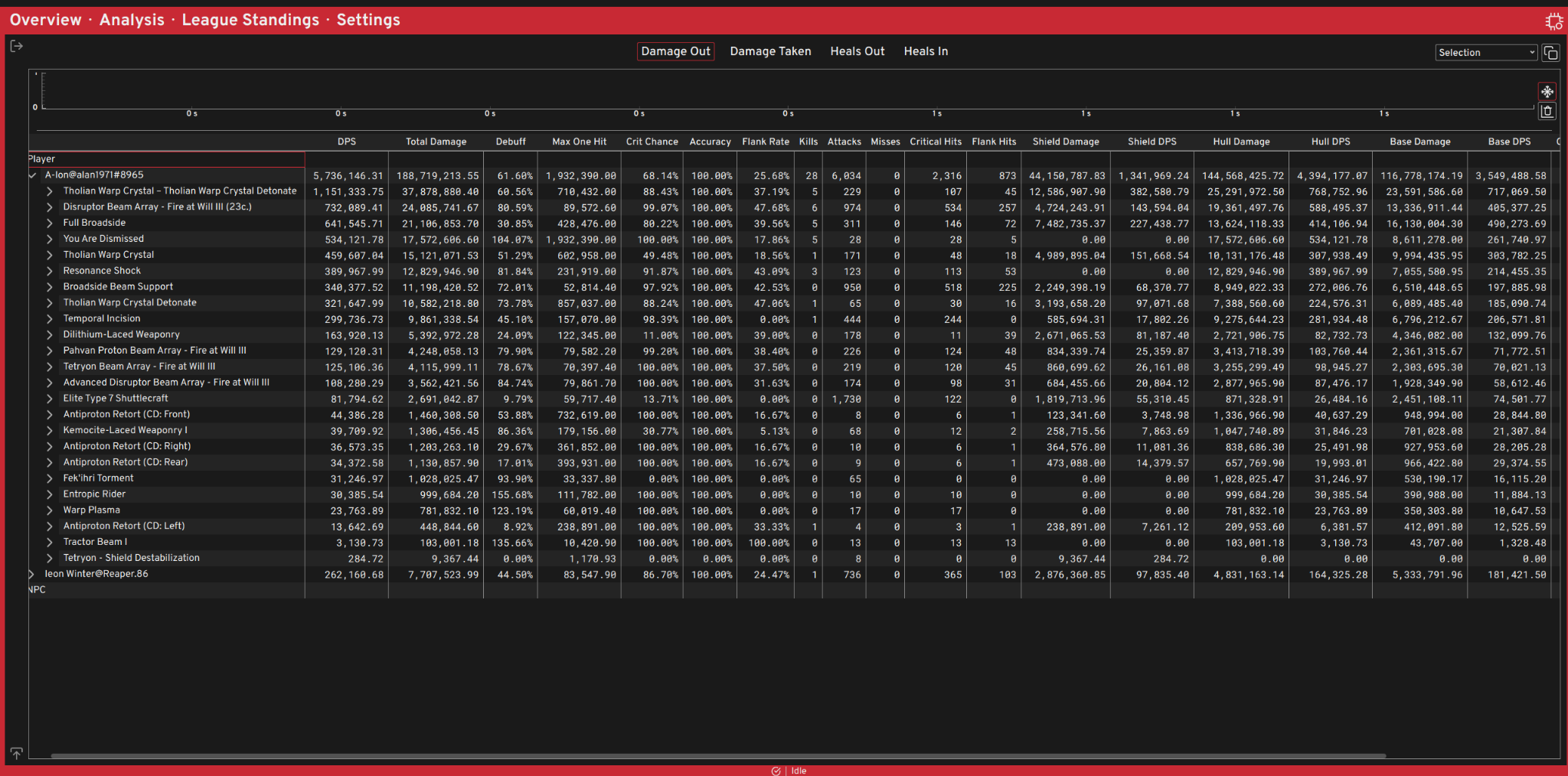
Evidence used for this guide
- October 15, 2026 build video: equipped slots, hover tooltips, abilities, traits, specializations, and active duty roster.
- October 15, 2026 HSE video and parser screenshot: power observations and damage rows.
- Alan’s explicit corrections and confirmations: six Temporal arrays, auxiliary-cost mitigation tests, pet choices, experimental trait swaps, and the reasons behind the equipment.
- Historical build information was used for identification only. It was not treated as evidence that an item remained equipped.
Tooltip descriptions can include effects added by traits and duty officers. They should not all be classified as innate weapon properties.
13 / Next review
Finish the skill tree. Then test the open questions.
Skill-tree explanation pending
Alan will walk through each selection and its purpose.
The recorded overview shows 11 Engineering, 10 Science, and 25 Tactical points. Individual nodes and the reasoning behind them will be added after Alan’s walkthrough. That explanation will follow Alan’s walkthrough.
Experiment queue
- Measure whether Isomags improve Temporal weapon damage, auxiliary behavior, or neither—and which modifiers matter.
- Test Temporal Incision stacking, refreshing, peak display values, and actual damage contribution.
- Separate the Tholian omni, core, and two-piece contribution through controlled comparisons.
- Correlate auxiliary-power dips with Dilithium Transporter activation windows.
- Compare Superior Area Denial and Terran Goodbye under matched pet and encounter conditions.
- Measure Cultural Conquest stacks, buff coverage, and the complete activation sequence.
Living guide: this page records the October 15 build. We will add the skill-tree reasoning and controlled test results in later updates, keeping changes distinct from this snapshot.
New mechanics lesson: Subsystem Power
Which power affects your damage, what firing costs, and why cost reduction matters.
Read the power lesson →